Newsletter – April 2025
1 April, 2025
A vast industrial sand mine is being proposed on Aboriginal Country in Tasmania’s north-east. Melaythenner Teeackana Warrana (Heart of Country) Aboriginal Corporation (MTWAC) is speaking out now – before irreversible damage is done.
THIS IS COUNTRY, NOT EMPTY SAND

BACKGROUND
Boobyalla is part of the traditional Country of the Coastal Plains Nation. For Aboriginal people, this is a living cultural landscape, carrying thousands of years of connection, history, knowledge and responsibility.
Known Aboriginal burial places occur across the surrounding north-east landscape. Country holds the presence of old people and generations who came before, whether or not every place has been recorded on a map.
The project’s own heritage assessment acknowledges the potential for human remains within the project area, and the difficulty of ever establishing their presence or absence through archaeological survey alone.
Country cannot be excavated and then restored. Once cultural value is destroyed, it is gone.
THE SCALE OF THIS PROPOSAL IS EXTRAORDINARY
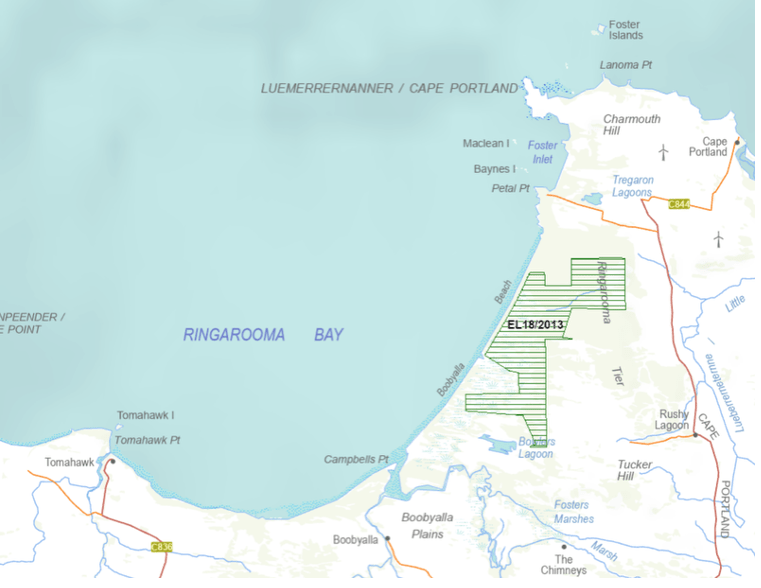
The proposed project area covers 713 hectares, including 592 hectares of mining area, 75 hectares of access roads and 46 hectares associated with the jetty area on Crown Reservation and offshore.
One of MTWAC’s Senior Rangers recalls being briefed on the proposal as he watched Cape Barren geese and black swans on the wetlands. Grasping the sheer scale of what was planned – hundreds of hectares of Country excavated for sand – he recalls, “It was jaw-dropping”.
North Scottsdale Resources has confirmed plans to dredge and process 70-100 million tonnes of sand over 35-40 years, with a new 700-metre jetty extending off Boobyalla Beach into Ringarooma Bay. The company says an application for a mining lease is imminent, with mining hoped to begin in late 2028. Bulk cargo carriers anchored and dumping ballast water into Ringarooma Bay.
Yet a proposal capable of transforming this landscape for generations is progressing with almost no little public awareness. And very little consultation, including with Aboriginal traditional owners of this ancient Country.
THIS LANDSCAPE IS LIVING AND IRREPLACEABLE
Boobyalla is part of a remarkable north-east coastal landscape. The project’s own assessment describes mobile coastal dunes, creeks running through the proposed mining area towards Ringarooma Bay, and wetland habitats formed between the dunes.
This is a connected system. Removing hundreds of hectares of sand will disturb the dunes, waterways, habitats and wildlife that make up that system. The consequences will not stop at the edge of the mine – and will not be reversible.
ABORIGINAL HERITAGE GOES BEYOND MARKS ON A MAP
A heritage assessment was undertaken across the proposed project area in 2024. It identified two Aboriginal heritage sites within the project area and 129 registered sites within approximately 10 kilometres. It acknowledged the potential for human remains within the project area. It also recorded concerns from Aboriginal organisations about impacts on cultural heritage and the broader landscape - and that organisations consulted did not support the project because of those concerns. Is their expectation that Aboriginal voices and concerns become merely a footnote in the approvals process?
We know that archaeological surveys cannot capture the full cultural value of Country. The assessment itself recognises that cultural, social and spiritual significance can only be determined by Aboriginal people.
A heritage assessment is not community consent.
Country carries meaning across landscapes, places, stories and connections. The question is not simply what can be found here, but what would be lost if this Country were excavated?
THIS MUST NOT BECOME INEVITABLE
The project has been under investigation for years, and the 2024 heritage assessment described it as reaching an advanced stage. That makes scrutiny urgent.
Now is the time to ask whether this project should happen at all – before further investment and regulatory momentum make it harder to stop.
Exploration is not consent. Economic interest in a resource does not create an entitlement to destroy Country.
RUSHY LAGOON IS ALREADY CONTROVERSIAL
Boobyalla forms part of Rushy Lagoon, where plans to convert large areas of agricultural land to plantation forestry have triggered major public concern and a proposed Parliamentary inquiry.
But the debate has focused on what happens on the land, not the very land itself. Any serious consideration of Rushy Lagoon’s future must also confront what is proposed for the Aboriginal Country beneath it.
ONCE IT IS GONE, WE CANNOT PUT IT BACK
A burial place cannot be recreated after it is destroyed. Cultural heritage removed with millions of tonnes of sand cannot simply be returned. An ancient landscape cannot be reconstructed once it is excavated away.
The heritage framework contemplates monitoring during sand extraction for previously unknown Aboriginal burials and relocating artefacts if they cannot be avoided. For MTWAC, protecting Country must mean more than finding cultural heritage after machinery arrives, or moving it out of the way.
The destruction of Juukan Gorge showed, with devastating clarity, what can happen when development is allowed to proceed despite the known significance of Country.
ENVIRONMENTAL IMPACTS
- Sensitive marine environment
- Impact of ballast water dumped into Ringarooma Bay
- Risk of vessel running aground
- Impacts to threatened species – Devils, Forrest Roos, Spotted Quolls, Echidna, and nesting birds
- Local birds - Cape Barren Goose, Australian Shelduck, Brown Quail, Wedge-tailed Eagle, Brown Falcon, Forest Raven, Yellow-tailed Black-Cockatoo, Australian Pipit and Gray Currawong
- The wetlands around Boobyalla Inlet, the Boobyalla River, and the Lower Ringarooma Ramsar site contain habitat that supports threatened freshwater fish, frogs, and coastal birds.
- The strongest evidence currently available indicates that the following threatened species should be treated as confirmed conservation values for the broader Boobyalla wetland and river system - Australian Grayling (Prototroctes maraena), Dwarf Galaxias (Galaxiella pusilla), Green and Gold Frog (Litoria raniformis), Fairy Tern (Sternula nereis)8
THIS CONCERNS EVERY TASMANIAN
MTWAC has a responsibility to speak for Country and for the generations who come after us.
But Boobyalla is also part of Tasmania’s shared inheritance: an extraordinary coastal landscape whose cultural and environmental values have survived for millennia.
Something so precious should not be extracted and shipped away before Tasmanians have even understood what is at stake.
MTWAC IS CALLING FOR ACTION NOW
MTWAC is calling on the Tasmanian Government and relevant authorities to halt progression of the proposed Boobyalla sand mine.
We are calling for:
- Aboriginal voices and the cultural values of the whole landscape to be heard, respected and protected before further commercial or regulatory momentum determines the outcome;
- full public disclosure of the proposed mine’s scale, extraction volumes, depths, duration, processing, transport and marine infrastructure;
- independent public scrutiny of potential impacts on Country, including dunes, wetlands, waterways, groundwater, wildlife, coastal processes and the marine environment;
- the proposed sand mine to be included in public and Parliamentary scrutiny of the future of Rushy Lagoon; and
- a decision about Boobyalla to be made before the damage is done - not afterwards.
MTWAC will be reaching out to Aboriginal organisations, environmental groups, community organisations, industry, government and Tasmanians across the state to stand with us in protecting this Country.
“Aboriginal heritage is not renewable.”
Uncle Vernon, Senior Aboriginal Heritage Officer and MTWAC member
COMING NEXT – HEAR FROM COUNTRY, TAKE ACTION.
This statement is only the beginning. In the coming days, filmmaker Anna Harding, will take us to Boobyalla – to see this Country, hear about its value directly from Aboriginal custodians, and understand what is at stake.
We will also be sharing resources for collective action – petitions to sign and letters to send to local MPs.
Sources cited
- Cultural Heritage Management Australia, Aboriginal Heritage Assessment Report: NSR Sand Extraction Project, Mining Lease EL18/2013, Rushy Lagoon, North East Tasmania, Final Draft V1, 30 April 2024.
- North Scottsdale Resources Pty Ltd, Exploration Licence EL18/2013, Year 1 Annual Report February 2015–2016, Mineral Resources Tasmania, 10 March 2016.
- Australian Government Department of Climate Change, Energy, the Environment and Water, Flood Plain Lower Ringarooma River Ramsar Site, updated 17 December 2025.
- Tasmanian Government, Terms of Reference for Rushy Lagoon inquiry announced, 10 August 2026.
- Gresham House, Rushy Lagoon / Tasmania Natural Asset Trust project information, 2026.
- Joint Standing Committee on Northern Australia, Never Again: Inquiry into the destruction of 46,000 year old caves at the Juukan Gorge in the Pilbara region of Western Australia — Interim Report, Parliament of Australia, December 2020.
- Rachel Williams, “New sand mine set for reveal,” North-Eastern Advertiser, 9 September 2026.
- Kilmartin-Lynch, S. & Hansen, C.J. (2025), “Sand Sovereignty and environmental justice: Indigenous governance, sustainable aggregates, and the transformation of land use in Australia”, Environmental Science & Policy, Vol. 174, 104264.
- Remsar www.dcceew.gov.au, Threatened Species Link www.threatenedspeciceslink.tas.gov.au, NRE nre.tas.gov.au.

Proposed site of the Boobyalla sand mine project (www.thelist.tas.gov.au)